Corbell
Multi-repo architecture graph, AI-powered spec generation, and architecture review — for backend teams that ship to production.


What problem does this solve?
You're a staff engineer or architect at a company where features touch 5–10 repositories.
Every quarter your team re-litigates the same architectural decisions: "should we use Kafka or SQS?", "why do we have three different auth patterns?", "who owns the rate-limiting layer?"
The decisions live in Confluence pages nobody reads, Slack messages nobody can find, and the memories of engineers who've since left.
When a new engineer joins—or even when you return to a service you haven't touched in 6 months—you're starting from scratch.
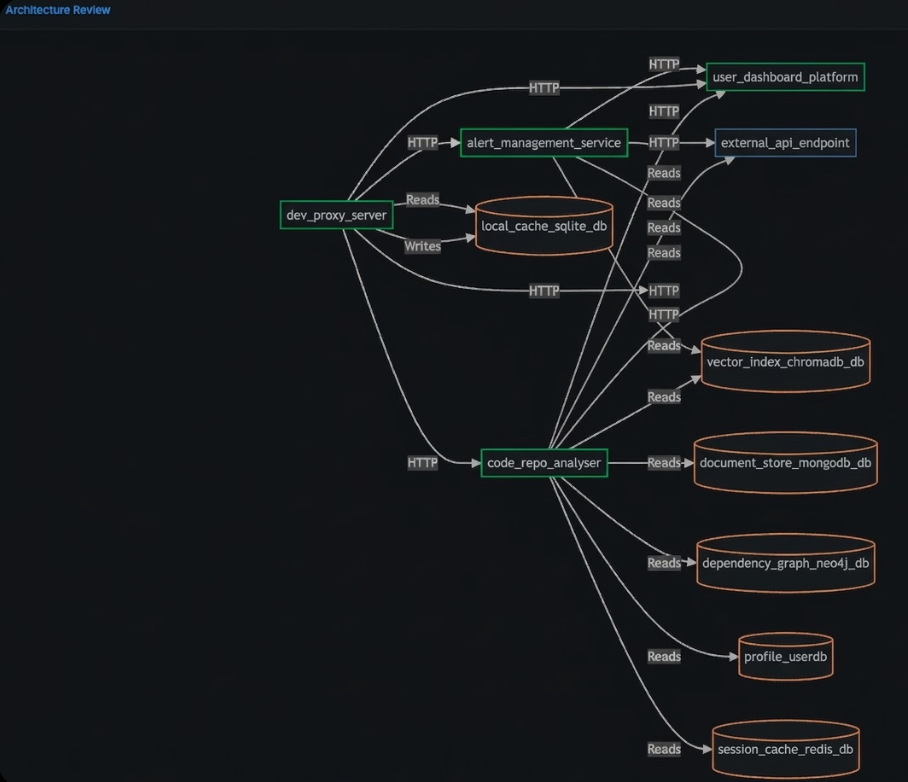
Corbell gives your team a living knowledge graph of your architecture — built from the actual code in your repos and your team's past design docs. When you need a new spec, Corbell generates one that respects your established patterns instead of inventing new ones. When you push to Linear, each task carries the exact method signatures, call paths, and cross-service impacts an AI coding agent needs to work autonomously.
How it looks
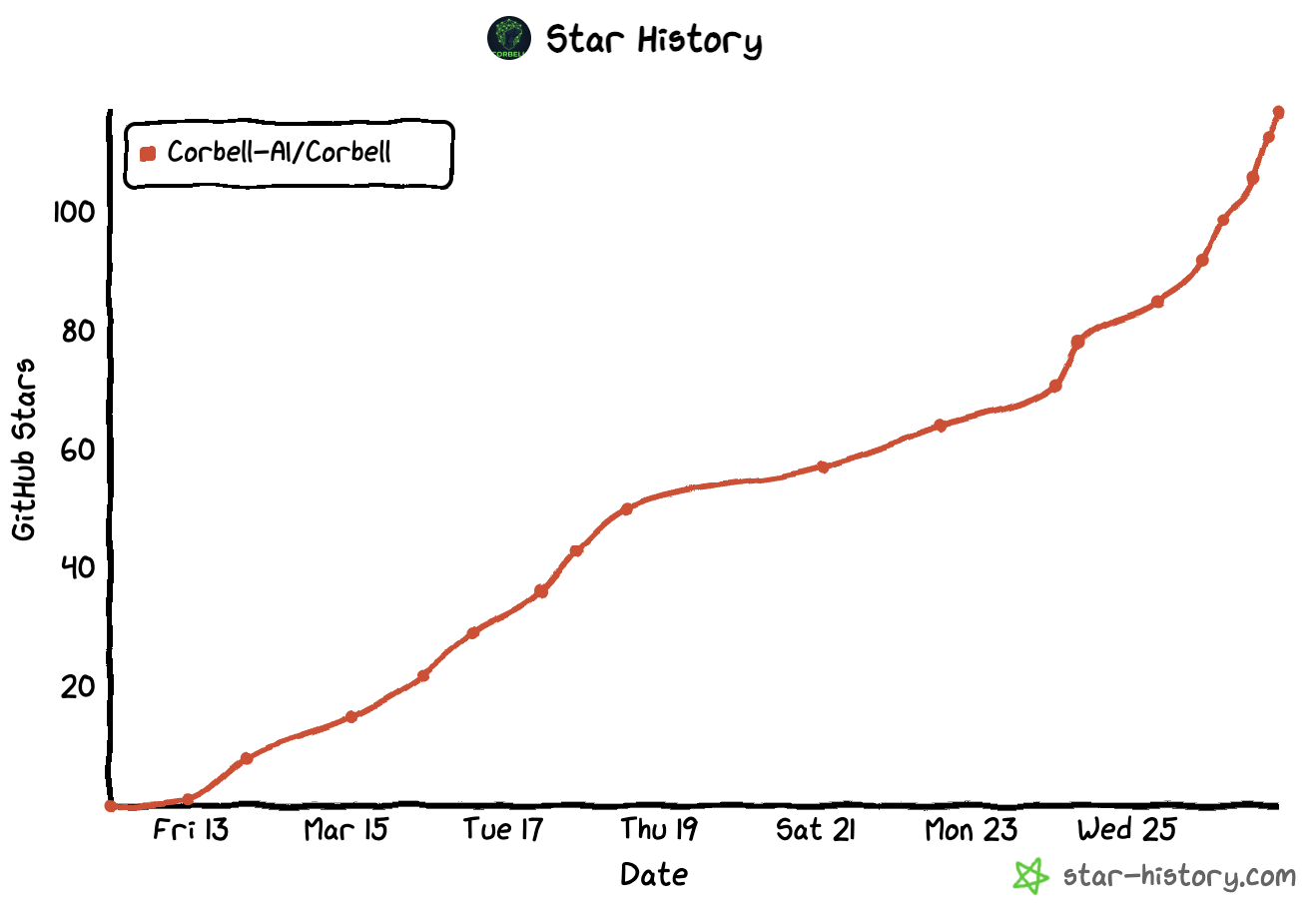
Star History (thank you)
How it works
Your repos → [graph:build] → Service graph (SQLite)
Your docs  → [docs:scan]   → Design pattern extraction
              ↓
  [spec new --feature "Payment Retry" --prd-file prd.md]
                 →  Generates 3-4 PRD-driven code search queries (LLM or regex)
                 →  Auto-discovers relevant services via embedding similarity
                 →  Injects graph topology + real code snippets
                 →  Applies your team's established design patterns
                 →  Calls Claude / GPT-4o to write the full design doc
                 →  Displays token usage and estimated cost
                 →  specs/payment-retry.md ✓
              ↓
  [spec review]    → Checks claims against graph → .review.md
  [spec decompose] → Parallel task tracks YAML
  [export linear]  → Linear issues with full method/service context
  [export jira]    → Jira issues via REST API v3 (reads from workspace.yaml)
No servers. No cloud setup. Runs entirely from your laptop against local repos.
Installation
pip install corbell

# With LLM support (pick one):
pip install "corbell[anthropic]"    # Claude (recommended)
pip install "corbell[openai]"       # GPT-4o

# With exports:
pip install "corbell[notion,linear,jira]"

# Everything:
pip install "corbell[anthropic,openai,notion,linear,jira]"
Requirements: Python ≥ 3.11
🚀 Quick Setup (2 minutes)
Prerequisites
- Python 3.8+ or Node.js 16+ or Go 1.19+ (based on your project)
- Git repository with source code
Essential Steps
-
Initialize Corbell workspace
corbell init✅ Creates
workspace.yamlin your project root -
Generate your first design document
corbell spec new --prd "Add user authentication feature"✅ Creates design document with auto-discovered services
-
View architecture graph (optional)
corbell ui serve✅ Opens browser at http://localhost:7433
Verify Setup
-
workspace.yamlexists in your project - Design document generated successfully
- Architecture graph loads (if using UI)
Need more details? See Full Documentation below.
📖 Full Documentation
Advanced Usage Guide
1. Initialize a workspace
cd ~/my-platform   # wherever your repos live
corbell init
Edit corbell-data/workspace.yaml:
workspace:
  name: my-platform

services:
  - id: payments-service
    repo: ../payments-service
    language: python        # python | javascript | typescript | go | java | csharp | rust | ruby | php

  - id: auth-service
    repo: ../auth-service
    language: go

llm:
  provider: anthropic   # or: openai, ollama, aws, azure, gcp
  model: claude-sonnet-4-5-20250929
  api_key: ${ANTHROPIC_API_KEY}
  context_budget: 100000  # Token limit for prompt context

integrations:
  jira:
    url: https://yourcompany.atlassian.net
    email: you@yourcompany.com
    api_token: ${CORBELL_JIRA_API_TOKEN}   # or paste directly
    project_key: ENG
    issue_type: Task                        # Task | Story | Bug
  linear:
    api_key: ${CORBELL_LINEAR_API_KEY}
    team_id: ${CORBELL_LINEAR_TEAM_ID}
2. Build the knowledge graph
corbell graph build --methods    # service + dependency graph + call graph, typed signatures, flows
corbell embeddings build         # code chunk index for semantic search
corbell docs scan && corbell docs learn   # extract patterns from existing RFCs/ADRs
3. Generate a design document
export ANTHROPIC_API_KEY="sk-ant-..."

# From a PRD file — services are auto-discovered, no --service flag needed
corbell spec new \
  --feature "Payment Retry with Exponential Backoff" \
  --prd-file docs/payment-retry-prd.md

# Spec with full call graph and infrastructure context
corbell spec new --feature "Auth Flow" --prd-file prd.md --full-graph

# Inline PRD
corbell spec new --feature "Rate Limiting" --prd "Tier 1: 100 req/min..."

# Document your existing codebase with no PRD at all
corbell spec new --existing

# Add existing design docs as context (ADRs, Confluence exports, RFCs)
corbell spec new --feature "Auth Token Refresh" --prd-file prd.md \
  --design-doc docs/auth-design-2023.md
Token usage and estimated cost are shown after every LLM call. Template mode (no LLM key) generates a structured skeleton with graph context filled in.
4. Document architecture constraints
Add a constraints block to any spec and all future specs will respect it:
<!-- CORBELL_CONSTRAINTS_START -->
- **Cloud provider**: Only Azure — no AWS services permitted
- **Latency SLO**: p99 < 200ms for all synchronous API calls
- **Security**: All PII encrypted at rest (AES-256) and in transit (TLS 1.2+)
<!-- CORBELL_CONSTRAINTS_END -->
corbell spec review checks proposed designs against these constraints. The corbell ui serve graph browser also surfaces them in a persistent bar at the bottom.
5. Review, approve, decompose, export
corbell spec review specs/payment-retry.md     # → .review.md sidecar
corbell spec approve specs/payment-retry.md

corbell spec decompose specs/payment-retry.md  # → .tasks.yaml

# Export to Linear
export CORBELL_LINEAR_API_KEY="lin_api_..."
corbell export linear specs/payment-retry.tasks.yaml

# Export to Jira (credentials in workspace.yaml)
corbell export jira specs/payment-retry.tasks.yaml
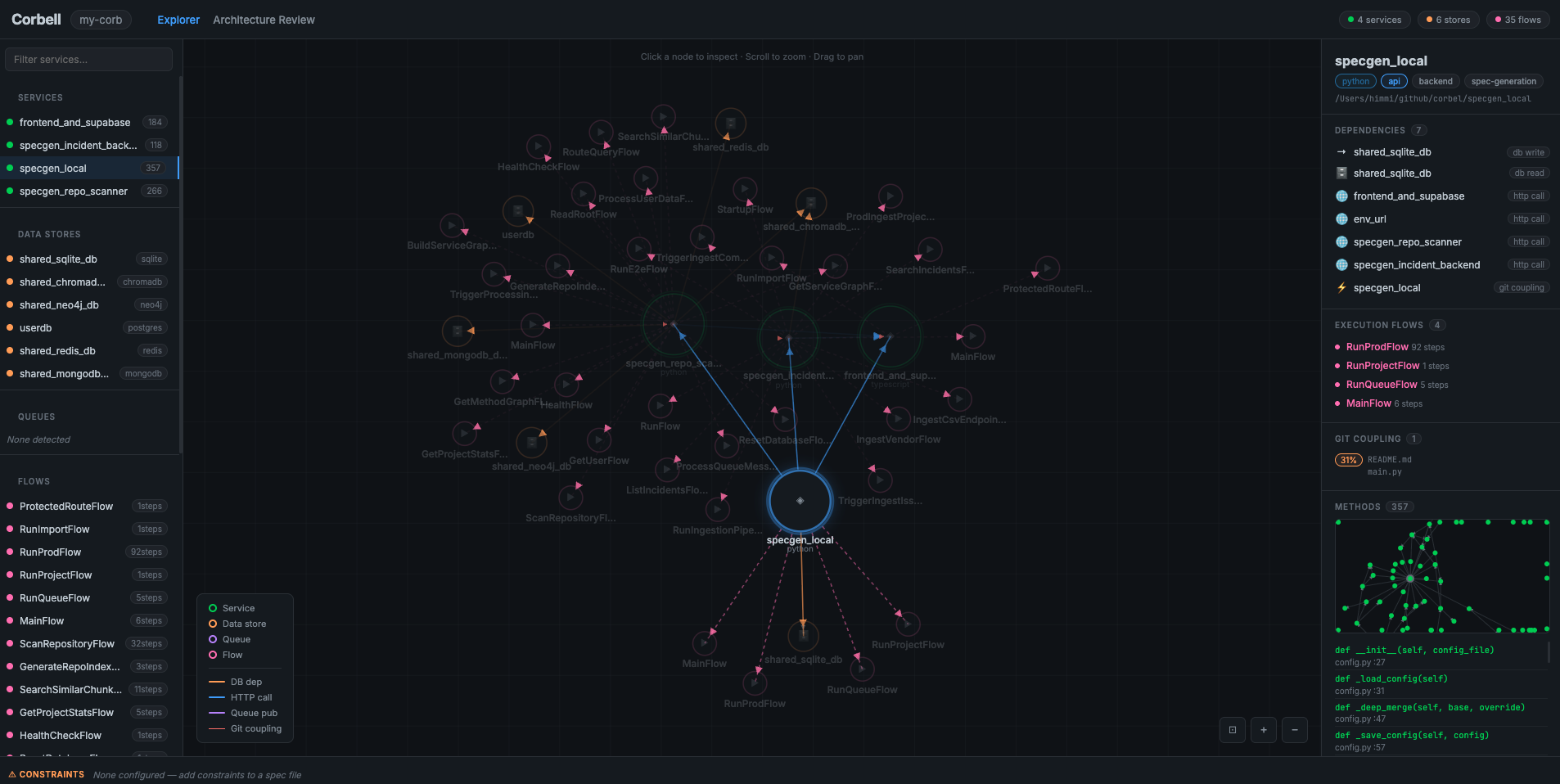
Architecture graph browser
corbell ui serve          # opens http://localhost:7433 · Ctrl+C to stop
corbell ui serve --port 8080 --no-browser
An interactive local graph view — no cloud, no sign-in, reads from your existing SQLite store:
- Force-directed graph — services (sized by method count), data stores, queues, execution flows. Zoom, pan, drag.
- Detail panel — click any service to see: language, dependencies, HTTP callers, typed method signatures, execution flows (e.g.
LoginFlow), git change coupling pairs with strength %. - Constraints bar — all
CORBELL_CONSTRAINTS_STARTblocks from your spec files shown as persistent amber pills at the bottom. Click to expand. - Sidebar — filterable service list, stores, queues, flows with search.
CLI Reference
graph       Service dependency graph
  build       --methods for call graph + typed signatures + git coupling + flows
  services    List discovered services
  deps        Show service dependencies
  callpath    Find call paths between methods

embeddings  Code embedding index
  build       Index code chunks
  query       Semantic search

docs        Design doc patterns
  scan / learn / patterns

spec        Design spec lifecycle
  new         --feature --prd-file --prd --design-doc --existing --no-llm
  lint        Validate structure (--ci exits 1)
  review      Check spec vs graph → .review.md
  approve / decompose / context

export      notion | linear | jira

ui          Architecture graph browser
  serve       --port (default 7433) --no-browser

mcp         Model Context Protocol server
  serve       stdio transport for Claude Desktop / Cursor

init        Create workspace.yaml
MCP – Model Context Protocol
Corbell exposes its architecture graph, code embeddings, and spec tools via MCP, so external AI platforms (Cursor, Claude Desktop, Antigravity) can query your codebase context directly.
Available Tools
| Tool | Description |
|---|---|
graph_query | Query service dependencies, methods, and call paths |
get_architecture_context | Auto-discover relevant services for a feature description |
code_search | Semantic search across the code embedding index |
list_services | List all services in the workspace graph |
Usage
# Default: stdio transport (for IDE integrations)
corbell mcp serve

# SSE transport (for web-based MCP clients / MCP Inspector)
corbell mcp serve --transport sse --port 8000
IDE Configuration
Cursor (~/.cursor/mcp.json):
{
  "mcpServers": {
    "corbell": {
      "command": "corbell",
      "args": ["mcp", "serve"]
    }
  }
}
Claude Desktop (~/Library/Application Support/Claude/claude_desktop_config.json):
{
  "mcpServers": {
    "corbell": {
      "command": "corbell",
      "args": ["mcp", "serve"]
    }
  }
}
If your IDE overrides the working directory, set the CORBELL_WORKSPACE environment variable:
env CORBELL_WORKSPACE=/path/to/my-platform corbell mcp serve
Auto service discovery
When you run corbell spec new, Corbell discovers which services are relevant to your PRD automatically — without you having to specify --service:
- Generates 3-4 natural-language code search queries from your PRD (using LLM or regex fallback)
- Encodes them with the same
sentence-transformers/all-MiniLM-L6-v2model used for indexing - Runs similarity search against all indexed code chunks
- Ranks services by how many of their chunks appear in the top results
- Auto-includes any services tagged as
infrastructure(e.g. AWS CDK repos) to provide comprehensive context - Selects the top-scoring services and builds context from them
Preview what would be discovered without generating a spec:
corbell spec context "Add exponential backoff retry to payment processing"
LLM providers
| Provider | Models | Key env var |
|---|---|---|
anthropic | claude-sonnet-4-5, claude-haiku-4-5 | ANTHROPIC_API_KEY |
openai | gpt-4o, gpt-4o-mini, gpt-4-turbo | OPENAI_API_KEY |
ollama | llama3, mistral, any local model | (none) |
aws | us.anthropic.claude-sonnet-4-* | BEDROCK_API_KEY or IAM |
azure | gpt-4o, any deployment | AZURE_OPENAI_API_KEY + AZURE_OPENAI_ENDPOINT |
gcp | claude-sonnet-4-5@20250514 | GOOGLE_APPLICATION_CREDENTIALS |
Advanced Topics
Architecture Details
Corbell runs entirely locally, no cloud required:
- Graph store: SQLite (default). Optional: Neo4j for large multi-repo topologies.
- Embeddings:
sentence-transformers/all-MiniLM-L6-v2(local). Storage backend is pluggable viastorage.embeddings.backendinworkspace.yaml. - UI: Python stdlib
http.server+ D3.js via CDN. Zero extra dependencies. - LLM: Not required for graph/embedding/UI commands. Claude/GPT-4o/Ollama for spec generation.
What graph build --methods extracts
| Signal | Languages | Result |
|---|---|---|
| Typed method signatures | Python, TS, Go, Java, C#, Rust, Ruby, PHP | MethodNode.typed_signature |
| Call edges | All 9 | method_call edges |
| DB/queue/HTTP dependencies | All 9 | DataStoreNode, QueueNode, http_call |
| Git change coupling | Any git repo | git_coupling edges with strength score |
| Execution flow traces | All 9 | FlowNode + flow_step edges |
| Infrastructure as Code | TS / JS | Auto-tags CDK/Terraform as infrastructure |
CI integration
# .github/workflows/spec-lint.yml
- name: Lint architecture specs
  run: |
    pip install corbell
    corbell spec lint specs/my-feature.md --ci
Development
git clone https://github.com/your-org/corbell && cd Corbell
pip install -e ".[dev]"
pytest tests/ -q
corbell --help
Roadmap
We are moving away from hardcoded procedural flows toward a fully agentic architecture. Instead of a fixed pipeline, Corbell will treat its core capabilities as dynamic tools:
- Features as Tools: Enabling agents to autonomously select when to query the graph, search embeddings, or analyze patterns based on the specific complexity of a feature request.
- Dynamic Reasoning: Moving the orchestration logic into the agentic layer so it can backtrack, refine queries, and cross-reference services without hardcoded sequence constraints.
- Agentic Review Flow: Self-correcting design docs where the agent uses the architecture graph as a real-time validator during the generation process.

License
Apache 2.0 — see LICENSE.