 MFS — Multi-source File-like Search
A context harness for AI agents — and for building them: one unified workspace over your code, memory, skills, docs, messages, and every data source.









Modern AI agents run on a huge amount of context — and it's sprawling, scattered, and siloed across dozens of sources and formats. That makes it hard to manage and harder to locate: for any given task, which slice of all that context is the part that actually matters? It piles up in:
- Code & repos — every repo the agent reads or writes
- Memory & skills — past-session transcripts, memory
.mdfiles, reusableSKILL.mdskills - Docs & knowledge — PDFs, design specs, Notion, crawled web pages
- Chat & mail — Slack, Discord, Gmail, Feishu
- Issues & CRM — Jira, Linear, HubSpot, Zendesk
- Databases & object stores — Postgres, Mongo, BigQuery, Snowflake, S3, Drive
MFS gathers it under one shell: every source becomes a file-like tree under a stable URI, driven by two skills your agent loads:
- 🗂️ mfs-ingest — the skill that bundles the commands for bringing sources
in:
mfs addregisters and indexes any connector (re-run to re-sync), andmfs connectorlists, inspects, and removes them. - 🔎 mfs-find — the skill that bundles the commands for finding across
what's ingested, in two families:
- Search —
searchandgrepfind things fast across huge volumes. - Browse —
ls,cat,tree,head,tailgive progressive, precise navigation down to the exact bytes.
- Search —
🚀 Quick start
Start the server
Server — start it in one terminal:
- Option A — uv tool (no clone; installs from PyPI, reads local paths directly)
uv tool install mfs-server && mfs-server run
Wait until the server logs show Application startup complete before switching to the client terminal.
- Option B — Docker Compose (isolated; builds the image from source)
git clone https://github.com/zilliztech/mfs.git && cd mfs

docker compose -f deployments/compose/docker-compose.yml up --build
The first build takes a few minutes. The ~600 MB embedding model downloads on the first mfs add and is cached in the mfs-data volume.
Install the CLI
Client — in another terminal, install the CLI and point it at the server:
cargo install mfs-cli
Set environment variables
# server address
export MFS_API_URL=http://127.0.0.1:13619

# option A: reads ~/.mfs/server.token automatically — no export needed
# option B: read the token the container auto-generated
export MFS_API_TOKEN="$(docker compose -f deployments/compose/docker-compose.yml exec -T mfs-server cat /data/server.token)"
Create a tiny sample tree:
mkdir -p /tmp/hello-mfs
echo "Print a greeting to the user." > /tmp/hello-mfs/greet.txt
Then index and search it:
mfs add --upload /tmp/hello-mfs
# --upload bundles + sends the tree to the container
# (omit it under option A: the server reads the path in place)
mfs search "where the greeting is printed" /tmp/hello-mfs
macOS: run
xattr -d com.apple.quarantine $(which mfs)once if prompted about an unidentified developer.
Skill install
Install the skills once:
# every project + every supported agent (drop -g for the current project only)
npx skills add zilliztech/mfs --all -g
Install to a specific agent
Pass one or more -a <agent>:
npx skills add zilliztech/mfs -a claude-code -a codex -g
<agent> can be claude-code, codex, cursor, windsurf, github-copilot,
gemini-cli, opencode, zed, cline, continue — 70+ agents in all.
Check for updates
npx skills check
npx skills update
For project-level installs, re-run the npx skills add command to update.
📥 Then open your agent (Claude Code, Codex, …) and ask in plain language. First, ingest something:
Use the mfs-ingest skill to spin up a tiny hello-world project in /tmp/hello-mfs
and ingest it
🔍 Then search and read across it:
Use the mfs-find skill to find where the greeting is printed in the hello-mfs
project, and show me the exact lines
🎉 That's it — you're up and running. From here, point MFS at your real sources.
🛠️ The first run is a one-time setup, and the agent walks you through it: it installs the
mfsCLI, helps you start a local server, and downloads a ~600 MB local embedding model into~/.mfs/. Give it a minute. After that the whole stack runs locally and offline — no API key, no GPU, no cloud account.Don't want the model download? If you already have an embedding-service API key (OpenAI, …), point the server at it instead — see Configure the server.
💡 Use cases
🧠 Your agent's memory and skills
Past-session memory files (.md, .jsonl) and reusable
skills become one searchable namespace — the prompt you tuned last week or a
decision logged three sessions ago, one query away.
The
mfsline is the CLI; the trailing#comment is the same request to an agent (/mfs-ingestor/mfs-find— Codex uses$mfs-ingest/$mfs-findinstead of/).
mfs add path/to/memory     # /mfs-ingest index my session memory
mfs add path/to/skills     # /mfs-ingest index my skills
mfs search "the prompt I tuned for refund disputes" --all   # /mfs-find the refund-dispute prompt
Output
file://local/.agents/memory/2026-05-31.jsonl  score=0.88
  {"role":"note","text":"refund-dispute prompt: lead with the order ID, then ..."}

file://local/.agents/skills/support-triage/SKILL.md  score=0.74
  ## Refund disputes — confirm the order ID first, then check the gateway log ...
Open the hit — mfs cat file://local/.agents/memory/2026-05-31.jsonl:
{"role":"note","text":"refund-dispute prompt: lead with the order ID, then ask
for the gateway transaction id; never promise a timeline before the dispute
window is confirmed."}
💻 Your codebases
Index the repos your agent reads or writes and grep them by meaning — find the helper by what it does, not the name you've forgotten.
mfs add path/to/repo   # /mfs-ingest index my repos
mfs search "where do we retry failed webhook deliveries?" path/to/repo   # /mfs-find our webhook retry logic
Output
file://local/repos/payments/webhooks/deliver.go  score=0.84
  87  // cap exponential backoff at 6 attempts, then dead-letter
  88  func (d *Dispatcher) retryDelivery(ev Event) error {

file://local/repos/payments/webhooks/deliver_test.go  score=0.69
  TestRetryDelivery_DeadLettersAfterMaxAttempts ...
Open the matching lines — mfs cat file://local/repos/payments/webhooks/deliver.go --range 80:110:
// retryDelivery re-sends a webhook with capped exponential backoff.
func (d *Dispatcher) retryDelivery(ev Event) error {
    for attempt := 1; attempt <= maxAttempts; attempt++ {
        if err := d.post(ev); err == nil {
            return nil
        }
        time.Sleep(backoff(attempt))
    }
    return d.deadLetter(ev)   // give up after maxAttempts
}
📄 Documents, images, any format
PDFs, Word docs, Markdown, screenshots — MFS converts each to text locally (PDF / docx → Markdown, no API key), and with a vision model on it describes images too. One search spans every format.
mfs add path/to/docs           # /mfs-ingest index my design docs
mfs add path/to/screenshots    # /mfs-ingest index my screenshots
mfs search "audit-log retention and the dashboards that show it" --all   # /mfs-find audit-log retention + dashboards
Output
file://local/design-docs/data-governance.pdf  score=0.86
  ... Audit logs are retained for 400 days, then moved to cold storage; access
  beyond 90 days requires a break-glass approval ...

file://local/screenshots/grafana-2026-06-02.png  score=0.71
  A Grafana dashboard; the p99 latency panel climbs to ~800 ms around 14:10,
  well above the 200 ms band on the other panels ...
Open the hit — mfs cat file://local/design-docs/data-governance.pdf:
# Data Governance — Audit Logs

Audit logs are retained for **400 days**, then moved to cold storage. Access
beyond 90 days requires a break-glass approval recorded in the change log.
☁️ Cloud drives and buckets
Mount a Google Drive or S3 bucket; its files become searchable text alongside your local ones — no syncing, no downloads.
mfs add gdrive://my-drive --config ./gdrive.toml   # /mfs-ingest add my google drive
mfs add s3://acme-exports --config ./s3.toml       # /mfs-ingest add our s3 exports bucket
mfs search "the Q3 board deck" --all               # /mfs-find the Q3 board deck
Output
gdrive://my-drive/Board/2026-Q3-review.pdf  score=0.87
  ... Q3 highlights: net revenue retention 118%, two enterprise logos closed ...

s3://acme-exports/finance/2026-q3-summary.csv  score=0.70
  quarter,net_revenue,nrr,churn  2026Q3,4.2M,1.18,1.4% ...
Open the hit — mfs cat gdrive://my-drive/Board/2026-Q3-review.pdf:
# 2026 Q3 Board Review

- Net revenue retention: 118%
- New enterprise logos: Globex, Initech
- Gross margin: 79% (+2 pts QoQ)
🌍 Online sources
Crawl a docs site or mount a GitHub repo with its issues — remote content lands in the same namespace as your local files.
mfs add web://docs.your-product.com                          # /mfs-ingest crawl our docs site
mfs add github://your-org/your-repo --config ./github.toml   # /mfs-ingest add our github repo
mfs search "how do we rotate signing keys?" --all            # /mfs-find signing-key rotation
Output
web://docs.your-product.com/security/key-rotation  score=0.88
  ... Signing keys rotate every 90 days. Trigger an early rotation from the
  admin console; the previous key stays valid for a 24-hour overlap ...

github://your-org/your-repo/issues.jsonl  score=0.75
  #312  "Automate signing-key rotation"  state=open  labels=[security]
Open the hit — mfs cat web://docs.your-product.com/security/key-rotation:
# Rotating signing keys

Signing keys rotate automatically every 90 days. To rotate early, open
Admin → Security → Keys and click "Rotate now"; the previous key stays valid
for a 24-hour overlap so in-flight tokens keep verifying.
💬 Team chat and tickets
Mount Slack, Gmail, Jira, Linear and pull the thread, the ticket, and the email behind a decision into one answer.
mfs add slack://acme --config ./slack.toml   # /mfs-ingest add our slack
mfs add jira://acme  --config ./jira.toml    # /mfs-ingest add our jira
mfs search "why did we revert the burst guard?" --all   # /mfs-find why we reverted the burst guard
Output
slack://acme/channels/platform/messages.jsonl  score=0.90
  [Tue 09:40] @carol: reverting the burst guard — it dropped healthy traffic
  [Tue 09:42] @dave:  agreed, reopening PLAT-491 to re-tune the window

jira://acme/teams/PLAT/issues.jsonl  score=0.81
  PLAT-491  "rate-limit guard misfires under burst"  state=Reopened
Read the ticket — mfs cat jira://acme/teams/PLAT/issues.jsonl --locator '{"id":"PLAT-491"}':
PLAT-491  rate-limit guard misfires under burst   state=Reopened
assignee: dave   priority: high
The burst guard dropped healthy traffic during the Tuesday spike; reverted in
PR #604. Re-tuning the window before re-enabling.
🎫 Customers and support
Pull your CRM and help desk together — the account, its open tickets, and the call notes behind a customer issue in one query.
mfs add hubspot://acme --config ./hubspot.toml   # /mfs-ingest add our hubspot crm
mfs add zendesk://acme --config ./zendesk.toml   # /mfs-ingest add our zendesk
mfs search "why is Globex unhappy with onboarding?" --all   # /mfs-find Globex onboarding issues
Output
zendesk://acme/tickets.jsonl  score=0.88
  #5821  "Onboarding blocked on SSO setup"  status=open  priority=high
  requester ops@globex.com — "third week without working SSO ..."

hubspot://acme/companies/globex/notes.jsonl  score=0.74
  call note: Globex renewal at risk; onboarding friction flagged by the CSM ...
Read the ticket — mfs cat zendesk://acme/tickets.jsonl --locator '{"id":5821}':
#5821  Onboarding blocked on SSO setup   status=open  priority=high
requester: ops@globex.com
"Third week without working SSO — the SAML metadata upload keeps failing with a
500. This is blocking our rollout."
🗄️ Production data
Point MFS at Postgres, Mongo, or BigQuery and search rows as text — each row is a
file-like object, so mfs cat pulls back the full record.
mfs add postgres://prod/orders --config ./pg.toml                         # /mfs-ingest add the prod orders table
mfs search "refunds stuck in pending over 7 days" postgres://prod/orders  # /mfs-find stuck pending refunds
Output
postgres://prod/orders  score=0.79
  {"id":"ord_8842","status":"pending","refund_requested_at":"2026-05-30",
   "amount":129.00,"gateway":"stripe","note":"customer disputed, awaiting ..."}
Read the full row — mfs cat postgres://prod/orders --locator '{"id":"ord_8842"}':
id                   ord_8842
status               pending
refund_requested_at  2026-05-30
amount               129.00
gateway              stripe
note                 customer disputed, awaiting gateway confirmation
🌐 One query across all of them at once
With a few sources registered, --all fans one query across all of them — files,
databases, trackers, chat — in a single result shape, so any hit copies straight
into mfs cat.
mfs search "rate-limit guard misfires under burst" --all # /mfs-find the burst rate-limit bug
Output
slack://acme/channels/oncall/messages.jsonl  score=0.91
  [Mon 22:14] @alice: ratelimiter pegged 500ms p99 tail, dump attached
  [Mon 22:18] @bob:   smells like the burst guard from PR #418

jira://acme/teams/PLAT/issues.jsonl  score=0.83
  PLAT-491  "rate-limit guard misfires under burst"  state=In Progress

file://local/repo/src/throttle.go  score=0.71
  42  func handleRateLimit(req Request) error {
Copy any hit into a read — same locators everywhere:
mfs cat ./repo/src/throttle.go --range 42:78
mfs cat jira://acme/teams/PLAT/issues.jsonl --locator '{"id":"PLAT-491"}'
First time adding a source and unsure what its TOML needs? Don't write it by hand — just tell your agent which source you want to index, and the mfs-ingest skill walks you through which credentials to grab (and where), then writes the config and registers it for you.
🧰 Commands
| Group | Command | What it does |
|---|---|---|
| Ingest & manage | mfs add <path|uri> [--config x.toml] | register a source and index it; re-run to re-sync |
mfs connector probe <uri> --config x.toml | dry-run a connection before registering | |
mfs connector list · inspect · remove | see and manage what's registered | |
| Search | mfs search "<query>" [<path|uri>] [--all] | hybrid semantic + keyword; scope to a path/URI, or --all |
mfs grep <pattern> <path> | exact keyword / full-text | |
| Browse & read | mfs ls <uri> · mfs tree <uri> | list one level, or a whole subtree |
mfs cat <uri> [--range a:b] [--locator '{...}'] | read the exact bytes, or one structured record | |
mfs head <uri> · mfs tail <uri> | sample the first / last entries | |
| Operate | mfs status | server, connectors, and jobs at a glance |
mfs job list · show <id> · cancel <id> | track indexing jobs | |
mfs config show | resolved endpoint / profile / token | |
mfs serve start · stop | manage a local server process |
Browse and search are complementary — no fixed order:
- Browse (
ls·cat·tree) — no index, fast and exact; best for walking a small or local tree. - Search (
search·grep) — needs an upfront index, then finds things fast across huge volumes with fuzzy matching; best for rough filtering.
Through an agent it's the same set in natural language, split across two skills:
mfs-find— search + browse:search·grep·ls·cat·tree·head·tail.mfs-ingest— register + manage:add·connector probe / list / inspect / remove.
🔌 Connectors
Local files are only the start. MFS speaks to a growing catalog of sources —
object stores, databases, code hosts, issue trackers, CRMs, chat, mail, docs —
and mounts each one as a URI tree you ls / cat / grep / search like a
local directory. Same verbs, same result shape, everywhere.
| Category | Source | URI prefix | What you search |
|---|---|---|---|
| 📁 Files & objects | Local files | file:// | any folder — text, Markdown, code, PDF, docx, images |
| Amazon S3 (& R2 / GCS / MinIO) | s3:// | bucket objects, converted to text | |
| Google Drive | gdrive:// | Docs, Sheets, PDFs and files in a Drive | |
| 🗄️ Databases | PostgreSQL | postgres:// | tables and rows as searchable records |
| MySQL | mysql:// | tables and rows as searchable records | |
| MongoDB | mongo:// | collections and documents | |
| BigQuery | bigquery:// | datasets and tables | |
| Snowflake | snowflake:// | databases and tables | |
| 💻 Code & issues | GitHub | github:// | repo files, issues, and PRs |
| Jira | jira:// | projects, issues, comments | |
| Linear | linear:// | teams, issues, comments | |
| 🧑💼 CRM & support | HubSpot | hubspot:// | contacts, companies, deals, notes |
| Zendesk | zendesk:// | support tickets and comments | |
| 💬 Chat & mail | Slack | slack:// | channels and message history |
| Discord | discord:// | servers, channels, threads | |
| Gmail | gmail:// | mail threads and messages | |
| Feishu / Lark | feishu:// | docs and messages | |
| 🌐 Docs & web | Notion | notion:// | pages and databases |
| Web | web:// | crawled pages, converted to Markdown |
New connectors slot in behind the same interface, so the catalog keeps growing. Each needs a small TOML (credentials + what to expose) — three ways to get it right:
- Ask your agent — describe the source in plain language; the
mfs-ingestskill finds the credentials, says where to get them, and writes the TOML. - Probe first —
mfs connector probe <uri> --config x.tomldry-runs a config, no registration and no writes. - Read the reference — each connector documents its exact fields and auth.
The connector TOML never holds a raw secret — it carries a reference (
env:VARorfile:/path), and the actual token, password, or credential file lives on the server (its process env or a mounted file). So the CLI and your agent never touch raw credentials, and a hosted MFS can have each user supply their own through the service instead of a file on disk.
🏗️ Architecture
Everything above runs the simplest way — client and server on one machine. The same MFS also scales to production; here's how it's put together.
MFS is a thin client over a stateful server, talking over one HTTP /v1 API:
- Client — the
mfsCLI, the SDKs, and the agent skills (mfs-find/mfs-ingest). Stateless, so re-creating it on a laptop, a CI runner, or an agent runtime is free. - Server — the setup wizard, all config / credentials / env vars, the queue
- workers, and the data backends. Everything that matters lives here, so
env:/file:secret references always resolve on the server, never the client.
- workers, and the data backends. Everything that matters lives here, so
┌────────────────┐                 ┌────────────────────────────────────────┐
│ CLIENT         │                 │ SERVER · mfs-server                    │
│ ────────────── │                 │ ────────────────────────────────────── │
│ mfs CLI        │                 │ setup wizard                           │
│ SDKs           │                 │ queue + workers                        │
│ skills         │                 │ config · env vars · credentials        │
│   · mfs-find   │ ── HTTP /v1 ──▶ │                                        │
│   · mfs-ingest │                 │ backends (scale up as needed):         │
└────────────────┘                 │   vector    Milvus Lite → Zilliz Cloud │
                                   │   metadata  SQLite → Postgres          │
                                   │   caches    local filesystem           │
                                   └────────────────────────────────────────┘
The only real deployment choice is where the server runs. Move it onto its own host (a VM or a single container), or scale it out across a Docker Compose stack or a Kubernetes cluster — the CLI and skills stay with you either way. The table below is a recommended layout per mode; for how to actually set each piece, see Configure the server.
| Piece | Local (one machine) | Single host (its own VM or container) | Distributed (Compose / Kubernetes) |
|---|---|---|---|
mfs CLI | your machine | your machine | your machine |
| Agent skills | your machine | your machine | your machine |
mfs-server + workers | your machine | the server host | the server cluster (api + worker pods) |
mfs-server setup wizard | your machine | the server host | the server cluster |
server.toml | your machine | the server host | the server cluster (ConfigMap / mounted file) |
| Connector credentials + secret files | your machine | the server host | the server cluster (Docker / k8s secrets) |
env: / file: ref values | your machine | the server host | the server cluster (pod env / mounted files) |
| Vector DB | Milvus Lite (local file) | self-hosted Milvus or Zilliz Cloud | Zilliz Cloud |
| Metadata DB | SQLite (local file) | Postgres | Postgres |
file:// ingest | server reads the path in place | CLI bundles + uploads the tree | CLI bundles + uploads the tree |
That last row is automatic: on a shared filesystem the server reads local paths directly; otherwise the CLI bundles and uploads them — no flags needed.
Through an agent you don't think about any of this — the skills already encode it. The agent detects whether client and server share a machine and adjusts (local read vs upload) on its own, so there's nothing about deployment mode to spell out in a prompt. Just use MFS normally.
For a split deployment, point the CLI at the server and you're set:
export MFS_API_URL=https://mfs.your-corp.internal
export MFS_API_TOKEN=...
mfs status
Docker images, a Compose file, and a Helm chart for split api / worker
deployments live under deployments/.
🏭 Built for production. MFS was built for production from day one — not a weekend demo. The split design scales to production-scale data: pair the vector backend with Zilliz Cloud's Vector Lakebase and MFS indexes and searches massive corpora, with the reliability and design choices below.
🔧 Configure the server
Almost all configuration lives on the server — the embedding provider, the
vector backend, the metadata database, caches, auth, and every connector's
credentials all sit in the server's server.toml. The client barely has any
config: a tiny TOML that just says which server to talk to (endpoint + token),
so pointing the CLI at a local or a remote server is the whole client story.
There are two ways to configure the server, and they write the same server.toml:
- The wizard —
mfs-server setupis a convenient interactive walk through the common choices (embedding provider, vector DB, database, cache, auth). Defaults are self-contained, so you can press Enter through to a working local server and opt into hosted backends (OpenAI, Zilliz Cloud, Postgres, …) only where you need them. - The TOML — everything the wizard writes, plus the advanced knobs it
doesn't surface (cache size / eviction, chunker thresholds, namespace, worker
counts, per-connector tuning), lives in
~/.mfs/server.toml. Edit it directly for anything beyond the basics.
Both run on the server's machine or container, not on the client — they write the server's
server.toml. In local mode (client and server on the same machine), that's simply your local machine.
mfs-server setup                      # full interactive walkthrough
mfs-server setup --section embedding  # re-run just one section
What each section of server.toml configures:
| Section | Configures | Default | Swap in |
|---|---|---|---|
[embedding] | embedding provider · model · dim | local ONNX (BGE-M3 int8, no key) | openai · gemini · voyage · jina · mistral · ollama · local — needs that provider's key/extra |
[milvus] | vector store | Milvus Lite (file under ~/.mfs/) | self-hosted Milvus or Zilliz Cloud — set uri + token |
[database] | metadata + transformation-cache DB | SQLite (file) | Postgres — set dsn |
[artifact_cache] | converted-blob cache | local fs under ~/.mfs/cache | size / eviction knobs |
[description] | image descriptions (vision LLM) | off | openai · anthropic · gemini — needs key |
[summary] | directory / file summaries | off | provider + model, dir / file scope |
auth_token | API auth | auto-generated server.token | a fixed token, or - to disable |
Secrets never sit in the TOML as plaintext — the TOML carries a reference
(env:VAR or file:/path) and the real value lives on the server (its
process env or a mounted credential file), resolved at runtime. The same holds
for every connector's credentials, so secrets stay on the server, never on the
client.
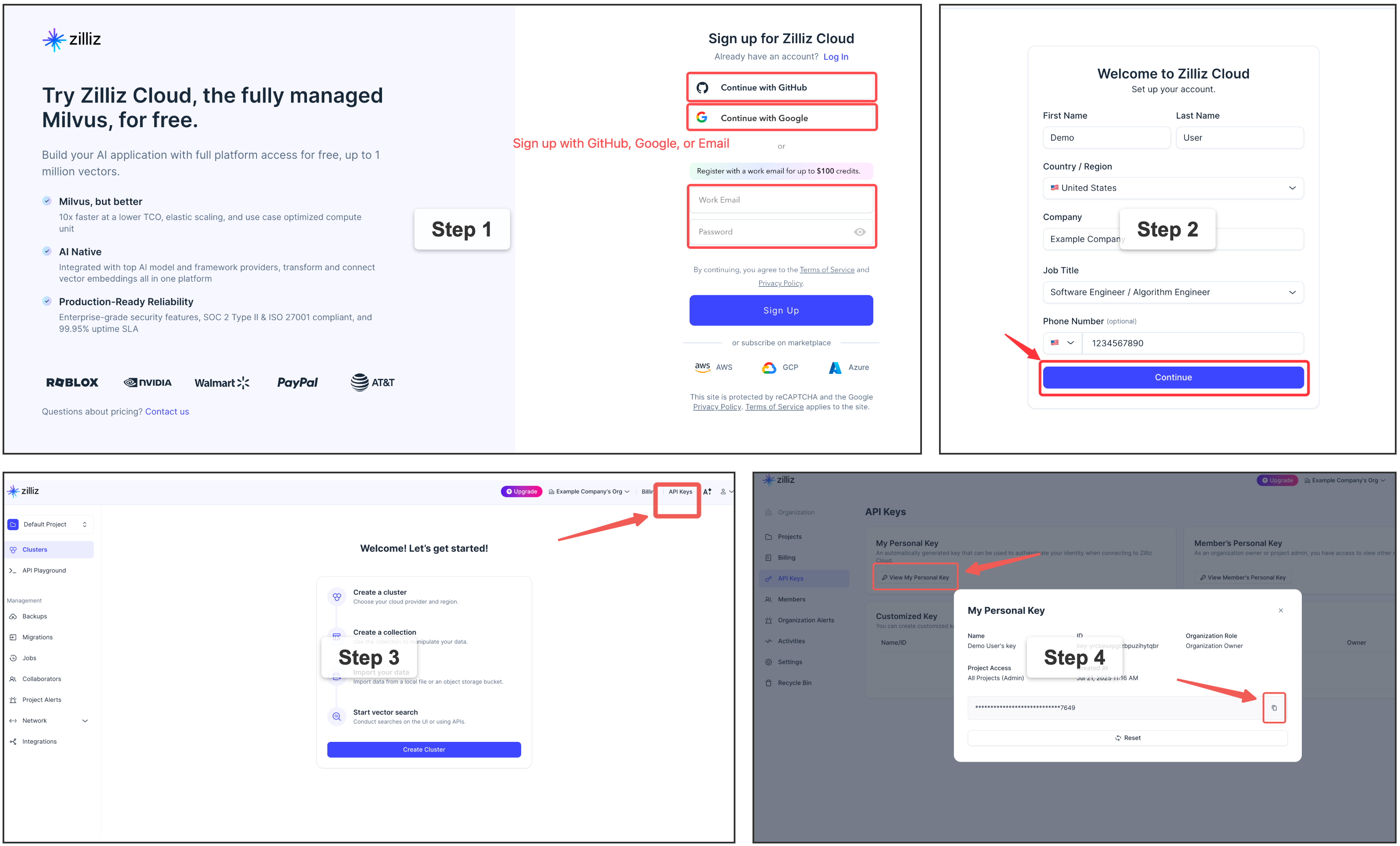
⭐ Get a free Zilliz Cloud cluster (URI + token)
For a fully managed vector backend,
sign up
for a free Zilliz Cloud cluster — the console gives you the public endpoint
(URI) and an API key (token). Put them in [milvus] as uri + token,
keeping the key out of the TOML with an env: ref.
Use OpenAI instead of the local model?
Set the embedding provider to OpenAI and export your key — no model download:
[embedding]
provider = "openai"      # instead of the default local "onnx"
export OPENAI_API_KEY=sk-...
✨ Features
- 🗂️ One file-like interface, any source. Whatever the source or format, it becomes a single file-like tree under a stable URI. Agents already speak shell, so there's no new query language and no per-source SDK — the same handful of verbs reach everything, and what you learn once carries across every connector.
- 🌐 Your whole workspace, one interface. Stop wiring a separate context harness for every scenario. Memory, code, docs, chat, tickets, databases — MFS unifies your entire working context, with its history and state, into one search-and-browse interface.
- 🔍 Search and browse, two legs of one loop. Hybrid semantic + keyword search locates fast across huge volumes; progressive browse then narrows to the exact bytes or rows. Together they lift precise recall and cut token spend — you pull in only what matters, and never trust a hit until you've reopened it.
- 🛡️ Local and production, equally at home. Run fully local and offline, or at production scale — neither is an afterthought. Every component is swappable and independently scalable, so the same MFS moves between the two by configuration alone. The index is derived and crash-safe: upstream stays the source of truth, so you can delete it and rebuild from the original sources, losing nothing.
- 🤖 Agent-native. Built for how agents actually work — especially context and memory management — so it slots into any agent setup. And when you're building an agent of your own, you can build it on top of MFS too.
🤖 Build agent applications on top of MFS
Beyond using MFS through an agent in your daily work, you can build on it — treat MFS as the retrieval/context base layer your own agent application sits on. The robust index pipeline and the broad connector catalog are already handled: you never touch embeddings, the vector store, or per-source plumbing — you point at MFS and focus on the app on top.
┌──────────────────┐   ┌──────────────────┐   ┌──────────────────┐
│ agents           │   │ your app code    │   │ your skills/MCP/ │
│ → skills + CLI   │   │ → SDK (Py / TS)  │   │ plugins → CLI    │
│ (use directly)   │   │ (BUILD ON IT)    │   │ (BUILD ON IT)    │
└────────┬─────────┘   └────────┬─────────┘   └────────┬─────────┘
         │                      │                      │
         └──────────────────────┼──────────────────────┘
                                ▼
┌────────────────────────────────────────────────────────────────┐
│ MFS  —  CLI · SDK · HTTP /v1                                   │
└───────────────────────────────┬────────────────────────────────┘
                                │
                                ▼
┌────────────────────────────────────────────────────────────────┐
│ index pipeline · chunking · embedding · vector DB · caches     │
│ a catalog of source connectors  (MFS owns all of this)         │
└────────────────────────────────────────────────────────────────┘
- SDK — call the generated Python / TypeScript clients under
sdks/straight from your application code (long-running daemons, services, language runtimes without a shell). - CLI — call the
mfscommand to build your own skills, MCP servers, or plugins on top of the same surface.
🧩 Examples: well-known projects, rebuilt on MFS
Every example under examples/ replicates a well-known project on
top of MFS — the same capability, in a fraction of the code — because MFS
already owns the part that used to be the hard part for each of them:
ingestion, chunking, embedding, the vector store, and hybrid search across many
source types. What's left is thin glue, or a single skill describing a strategy.
claude-context— a replica of claude-context ("make the codebase the context for any coding agent"): an MCP server exposingsearch+readover MFS, about 60 lines.deep-research-skill— the "reason and search over private data" job deep-searcher does as a standalone framework, done here as a single skill on top ofmfs-find— no vector-DB glue, no provider matrix, no custom retrieval-loop code.open-tag-skill— a self-hosted homage to Claude Tag, Anthropic's hosted@ClaudeSlack teammate:@mentiona bot in Slack —@OpenClaudeor@OpenCodex— and it gathers authorized MFS context and runs the task on a CLI agent backend.
See examples/README.md for the full list, or each
example's own README for its install command and walkthrough.
🗺️ Roadmap
- Multiple processing profiles — run different sources through different pipelines from one server: a code-tuned embedding model for your repos, a multilingual one for your docs. Because models differ in dimension and vector space, each profile maps to its own collection (a single one can't mix them), and you search within a profile or across all.
- Multi-user credentials and access control — per-user secrets and permissions, so a shared or hosted MFS can serve many users safely.
- A wider connector catalog — the set of sources keeps growing.
🙏 Acknowledgements
MFS is shaped by several related projects:
- claude-context, memsearch, and deep-searcher — earlier Zilliz code-search, memory-search, and deep-research efforts whose community feedback shaped MFS's agent-facing direction.
- VKFS — a sister exploration of a Unix-like interface for agent access to vector-backed knowledge.
⚖️ License
Apache-2.0. See LICENSE.