Personal OS — a memory for Claude Code
Your AI forgets everything the moment you close it. Every session you re-explain who you are, what you're building, and what you already decided last time.
This fixes that. It's a folder of plain text files that gives Claude Code a lasting memory — of you, your projects, your decisions, and the mistakes you told it not to repeat. It grows as you use it, and it all lives on your machine as Markdown you can read, edit, and back up. No database, no cloud, nothing leaves your computer.
You don't configure anything. You open the folder and say start — it interviews you for a bit and builds your personal setup with you. It ships blank; nothing here is anyone else's data.
What you actually get
- 🧠 Remembers you across every session — stop re-introducing yourself and your goals each time.
- 📂 Tracks your projects and decisions — pick up exactly where you left off, days or weeks later.
- 🪞 Learns your preferences and stops repeating corrected mistakes — it keeps a running list and checks it.
- 🔎 Finds anything you've ever told it by meaning, not just keywords (optional, runs a small model fully offline).
- 📝 Everything is plain Markdown in a git folder you own — read it, grep it, diff it, back it up, take it anywhere.
Think of it as a second brain for your AI: memory (it knows you) + execution (it tracks the work) + mirror (it reflects your patterns back and improves).
▶ Launch in 10 seconds
One word runs the whole setup — no commands, no steps to remember.
- Already have this folder open in Claude Code? → just type:
start - Starting from the repo link? → in Claude Code, say: "Clone
<your-repo-url>, open it, and run start"
That's it. start greets you, asks a few questions, and builds your personalized space with you — you just talk.
📖 New here? The 1-page guide tells you everything in plain language.
How it works
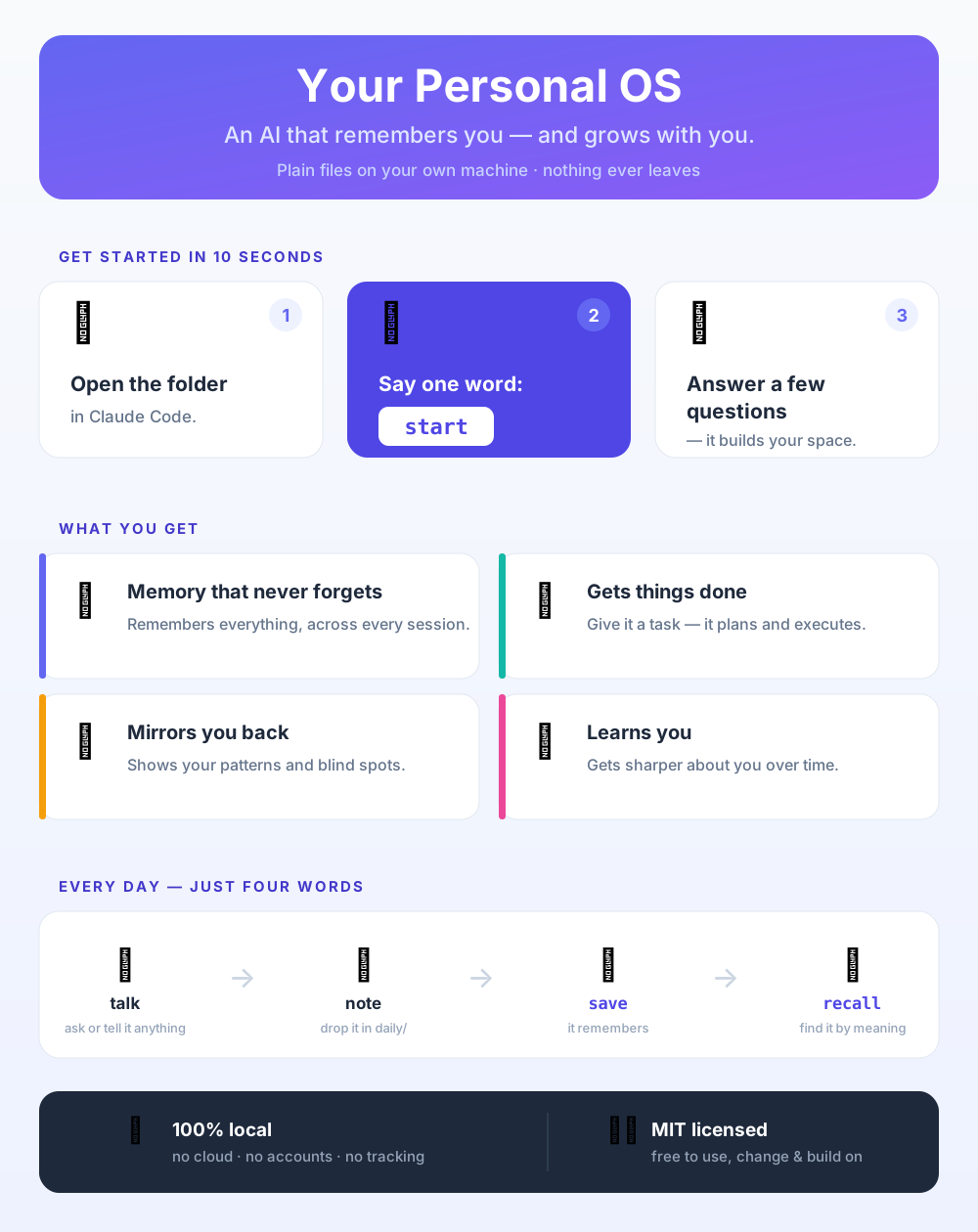
Want the architecture deep-dive? See the poster in docs/architecture.png or open docs/architecture.html in a browser.
Quickstart
1. Open this folder in Claude Code.
cd pos-starter
claude
2. Say start. That's the whole quickstart. start runs the setup with you end-to-end: it gets to know you (a guided self-portrait — life state, drivers, balance wheel, friction points), then builds your living vault (context/root.md identity anchor, context/identity.md, starter goals, anti-patterns, knowledge-graph skeleton), and turns on semantic memory. From here it's yours — talk to it, dump notes into daily/, grow knowledge/.
Prefer to drive it manually? (what start does under the hood)
start just orchestrates these skills so you never type them. You can run them yourself:
/svoboda-profiler <yourname>   # guided self-portrait → writes profile.yaml
/vault-scaffolder <yourname>   # turns profile.yaml into your personalized vault
Semantic memory — /recall finds notes by meaning, not just keywords. start sets this up for you; to do it by hand it's a one-time local setup (Python + a ~309 MB model, downloaded once, then fully offline):
bash scripts/memory_index_setup.sh                       # venv (~1 GB: numpy, onnxruntime, transformers)
.memory_venv/bin/python scripts/memory_index.py build    # embeds your vault → state/memory-index/
Skip it and everything still works — the graph falls back to grep, and the recall hook stays silent until you build the index.
What's inside
CLAUDE.md/AGENTS.md— boot rules (operating rules, orchestration, memory map).context/— rules, goals, lessons, anti-patterns, andworkflow-doctrine.md(how/when to orchestrate multi-agent workflows). Filled/personalized by the scaffold.knowledge/— your knowledge graph: one Markdown file per entity, linked with[[wikilinks]].state/·daily/·reports/— cross-context state, daily notes, generated artifacts.memory/— long-term memory store and session saves.
Optional modules
A module is an extra skill you plug into the engine. The engine ships with no modules of its own — only one worked example (modules/example-skill/), off by default.
To see the mechanism: flip enabled: true for example-skill in modules.yaml, then run /enable-modules — it creates the declared directories and copies the seed files (it never overwrites your data). Do not copy module folders manually.
To make your own: copy modules/example-skill/ to modules/<yourname>/, edit its SKILL.md, add a matching stanza in modules.yaml, and enable it. That one example is the template, the test, and the how-to in a single folder.
Notes
- Time: the profiling interview is deep — budget ~90–120 min. Do it across as many sittings as you like: stop after any domain, then say
startagain to pick up where you left off (it resumes, never restarts). - Run it in your own copy of this folder —
/vault-scaffolderoverwritesCLAUDE.mdand fills the context files, so don't point it at a workspace you care about for anything else. <yourname>is a slug: lowercase + hyphens, no spaces —/svoboda-profiler marcus-reyes.- Platform: needs a POSIX shell (macOS, Linux, or Windows + WSL2/Git Bash) — the same requirement as Claude Code itself.
- Dependencies (two tiers):
- Core — pure Markdown: profiler, scaffolder, knowledge graph, daily notes,
/dream,/reflect,/session-*. Needs only Claude Code + a POSIX shell +python3(stdlib only, for the wikilink-lint hook). Nothing to install. - Optional semantic memory (
/recall+ the grep-augmenting hook +/dreamindex update): needspython3+pip, thenbash scripts/memory_index_setup.sh(a ~1 GB venv: numpy / onnxruntime / transformers / huggingface_hub / sentencepiece) and onememory_index.py buildthat downloads a ~309 MB local model from HuggingFace (internet required once; no API key). It fails open — until you build it,/recalland the hook just no-op and the core keeps working. /ingestYouTube path also needsyt-dlp(brew install yt-dlporpip install yt-dlp).
- Core — pure Markdown: profiler, scaffolder, knowledge graph, daily notes,
- Not using Claude Code? Skills are plain Markdown — tell your agent: "read
.claude/skills/<name>/SKILL.mdand follow it" (start withstart— it orchestrates the rest). SeeAGENTS.md+context/agent-runtime.md.
Privacy
This repo ships blank — your data stays on your machine. Files are local Markdown; there's no telemetry and no external sync unless you set one up yourself.
License
The engine (boot logic, skills, rules, templates, docs) is MIT-licensed — see LICENSE. Use it, change it, ship it, build on it freely; just keep the copyright notice.
Your own content on top of the engine (your profile.yaml, identity, knowledge graph, daily notes, memories) is yours — the license doesn't touch it.
Copyright (c) 2026 xcota.