scalpel

by anshaneja5Verified

The surgeon skill for AI agents: the smallest cut that heals. Tops ponytail's own benchmark on every cell — less code, fewer tokens, lower cost, 100% correct.

3
Stars
0
Forks
Python
Language
8/24/2026
Added
View on GitHubDownload ZIP

⚠️ Third-Party Software Notice

This skill is third-party open-source software developed and hosted independently on GitHub. SkillTip is an informational directory and does not control or maintain the underlying repository. Any security checks displayed are automated and limited in scope. Review the source code before installing.

Read the Terms of Service

Installation

Add to your Claude Code skills directory:

# Add to your Claude Code skills
git clone https://github.com/anshaneja5/scalpel

Getting Started

Guides for using skills like scalpel.

Security Report

Verified

Last scanned: —

{
  "status": "PASSED",
  "issues": []
}

README.md

Scalpel, the surgeon

Scalpel

She reads the chart. She makes one cut. Nothing vital is ever touched.

The smallest cut that heals.


You know the other guy — long ponytail, oval glasses, replaces your fifty lines with one. Great. But sometimes the line he deletes was the one checking your input, and an independent 480-build benchmark caught him trimming everyday bad-input handling on 5 of 24 tasks, and his ladder re-deliberates every single turn of an agent session, quietly billing you for the meditation.

Scalpel puts a surgeon in your agent instead. She plans the operation once, reuses what the body already has (your codebase, the stdlib, the platform) before grafting anything new, makes the smallest incision that actually heals — and never severs an artery. Validation, error handling, security, and accessibility are anatomy, not fat.

Before / after

You ask for a date picker. Your agent installs flatpickr, writes a wrapper component, adds a stylesheet, and starts a discussion about timezones.

With scalpel:

<!-- scalpel: the browser has one -->
<input type="date">

Same one-liner the lazy guy writes — but when you ask for an email validator, scalpel's version still rejects garbage input. Minimal never means flimsy.

How it works

Before cutting, the surgeon reads the chart, then prefers what already exists:

1. Does this need to exist?    → no: don't operate (YAGNI)
2. Already in this codebase?   → grep for it, reuse it
3. Stdlib / native platform?   → use it
4. Installed dependency?       → use it — never add a new one for a few lines
5. Only then: new code         → the minimum that works

Then three rules the ladder guys don't have:

  • One incision. The plan is decided once, then executed — no re-deliberating the operation every response. That per-turn meditation is where minimalism skills quietly spend your tokens.
  • Anatomy list. Input validation at trust boundaries, error handling, security, accessibility: never cut, and the final diff is checked for exactly that.
  • Silent hands. Code first, at most two lines of prose. [code] → skipped: [X], add when [Y].

Numbers

Measured on the same harness ponytail uses (vendored from their repo, MIT — same 5 tasks, same execution-based correctness gate, same LOC counter), four arms, 3 Claude models × 10 repeats per cell (n=50), no cache.
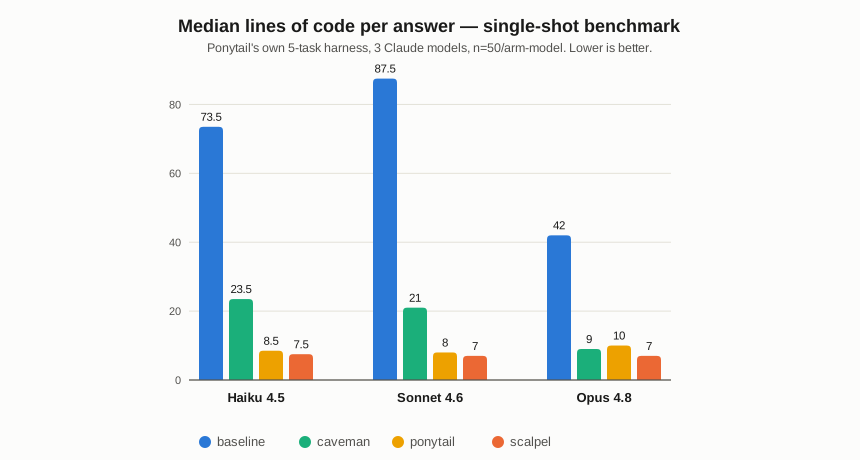
Median lines of code per answer across baseline, caveman, ponytail, and scalpel, on Haiku 4.5, Sonnet 4.6, and Opus 4.8. Scalpel is lowest on every model.

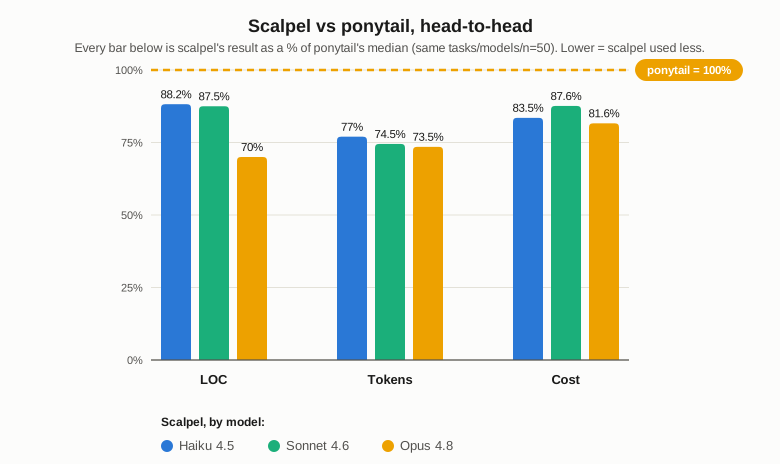
Scalpel vs ponytail, head-to-head:

Scalpel's LOC, tokens, and cost as a percent of ponytail's median, per model. Every bar sits below ponytail's 100% reference line.

modelLOCtokenscostlatencycorrectness
Haiku 4.5−12%−23%−10%−4%100% vs 96%
Sonnet 4.6−13%−25%−12%tietie (100%)
Opus 4.8−30%−27%−20%−13%tie (100%)

Beats or ties on every cell, loses none — and vs the no-skill baseline: ~90% less code at ~4× lower cost. Ponytail's only correctness failures in the run were real: it prescribed email_validator, a package that wasn't installed, and the code died — the exact "artery" scalpel's dependency rule guards. Full tables, failure notes, and honesty caveats: benchmarks/results/2026-07-03-single-shot.md.

Agentic (real headless Claude Code sessions on a real FastAPI+React repo, ponytail's own harness, 12 features + 7 adversarial safety tasks): a statistical tie with ponytail — scalpel edges LOC, time, and over-engineering flags; ponytail edges cost by ~3%; both 100% correct, 100% safe, both ~69% less code than no-skill, and the completeness judge confirms scalpel's low LOC isn't stub-shipping (3.00/3, min 3, every cell). Where ponytail's README admits its per-task cut is "near zero on already-minimal code", scalpel holds the same floor while winning the single-shot suite outright. Details: benchmarks/results/2026-07-03-agentic.md.
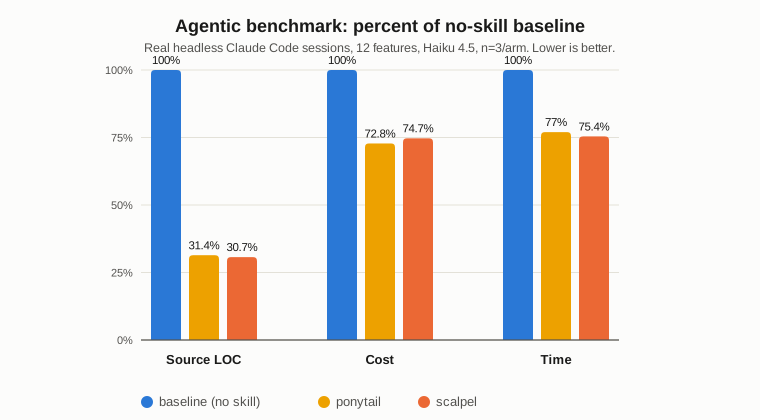
Agentic benchmark results as a percent of the no-skill baseline for source LOC, cost, and time. Ponytail and scalpel land within a few points of each other on every metric, both far below baseline.

Reproduce:

cd benchmarks
ANTHROPIC_API_KEY=... npx promptfoo@latest eval -c promptfooconfig.yaml --repeat 10
npx promptfoo@latest view

Install

Claude Code (plugin):

/plugin install scalpel

Or drop skills/scalpel/SKILL.md into .claude/skills/scalpel/ in any project, or paste it into the system prompt of any agent that takes one.

Boundaries

Scalpel governs what you build, not who you are. "stop scalpel" / "normal mode" turns it off. If you explicitly ask for the fuller version of something, she builds it — a surgeon doesn't argue with informed consent.

Credits

Benchmark harness vendored from DietrichGebert/ponytail (MIT) so every comparison is apples-to-apples on their scoreboard. Caveman arm from JuliusBrussee/caveman (MIT).

License

MIT

Frequently Asked Questions

What is scalpel?

scalpel is an open-source ai agents skill for AI coding assistants such as Claude Code, Codex CLI, and ChatGPT, built by anshaneja5. The surgeon skill for AI agents: the smallest cut that heals. Tops ponytail's own benchmark on every cell — less code, fewer tokens, lower cost, 100% correct. It has 3 GitHub stars.

Is scalpel safe to use?

Yes. scalpel passed SkillsLLM's automated security scan — a dependency vulnerability audit plus prompt-injection heuristics — with no high-severity issues. You can read the full report in the Security Report section on this page.

How do I install scalpel?

Clone the repository with "git clone https://github.com/anshaneja5/scalpel" and add it to your Claude Code skills directory (see the Installation section above).

What programming language is scalpel written in?

scalpel is primarily written in Python. It is open-source under anshaneja5 on GitHub, so you can review or fork the full source.

Are there alternatives to scalpel?

Yes. SkillsLLM lists many other AI Agents skills you can browse and compare side by side. Open the AI Agents category from the badge at the top of this page, or use the Related Skills and comparison links further down to weigh scalpel against similar tools.

Comments (0)

No comments yet. Be the first to share your thoughts!

ECC

by affaan-m

10

The agent harness performance optimization system. Skills, instincts, memory, security, and research-first development for Claude Code, Codex, Opencode, Cursor and beyond.

242,21936,702JavaScript
AI Agentsai-agentsanthropicclaude-code
View details
15

An agentic skills framework & software development methodology that works.

234,96620,863Shell
AI Agentsai-agentsbrainstorming
View details

The agent harness performance optimization system. Skills, instincts, memory, security, and research-first development for Claude Code, Codex, Opencode, Cursor and beyond.

185,94028,768JavaScript
AI Agentsai-agentsanthropicclaude-code
View details

cc-switch

by farion1231

3

A cross-platform desktop All-in-One assistant for Claude Code, Codex, OpenCode, OpenClaw, Grok Build & Hermes Agent. Only official website: ccswitch.io

128,8688,826Rust
AI Agentsclaude-codeai-tools
View details

claude-code

by anthropics

Claude Code is an agentic coding tool that lives in your terminal, understands your codebase, and helps you code faster by executing routine tasks, explaining complex code, and handling git workflows - all through natural language commands.

120,03119,897Shell
AI Agents
View details

Developers Also Liked

Based on votes and bookmarks from developers who liked this skill

ECC

by affaan-m

10

The agent harness performance optimization system. Skills, instincts, memory, security, and research-first development for Claude Code, Codex, Opencode, Cursor and beyond.

242,21936,702JavaScript
AI Agentsai-agentsanthropicclaude-code
View details
15

An agentic skills framework & software development methodology that works.

234,96620,863Shell
AI Agentsai-agentsbrainstorming
View details

n8n

by n8n-io

12

Fair-code workflow automation platform with native AI capabilities. Combine visual building with custom code, self-host or cloud, 400+ integrations.

201,88160,308TypeScript
MCP Serversapisai-tools
View details

The agent harness performance optimization system. Skills, instincts, memory, security, and research-first development for Claude Code, Codex, Opencode, Cursor and beyond.

185,94028,768JavaScript
AI Agentsai-agentsanthropicclaude-code
View details

cc-switch

by farion1231

3

A cross-platform desktop All-in-One assistant for Claude Code, Codex, OpenCode, OpenClaw, Grok Build & Hermes Agent. Only official website: ccswitch.io

128,8688,826Rust
AI Agentsclaude-codeai-tools
View details