idea-to-ship
Composable Agent Skills — for Claude and OpenAI Codex — that take an idea from fuzzy → validated → sequenced build → shipped: by hand, or on autopilot.
Most "build with AI" workflows skip the hard half. They jump straight to code — and skip deciding what's actually worth building, validating it honestly, and planning the build so it ships in safe, verifiable steps. idea-to-ship is that missing front half — plus the autonomous build loop on the far side of it: a small, sharp suite of Agent Skills (they run in Claude and OpenAI Codex), reverse-engineered from real idea→ship journeys (including the mistakes those journeys made), so you don't repeat them.
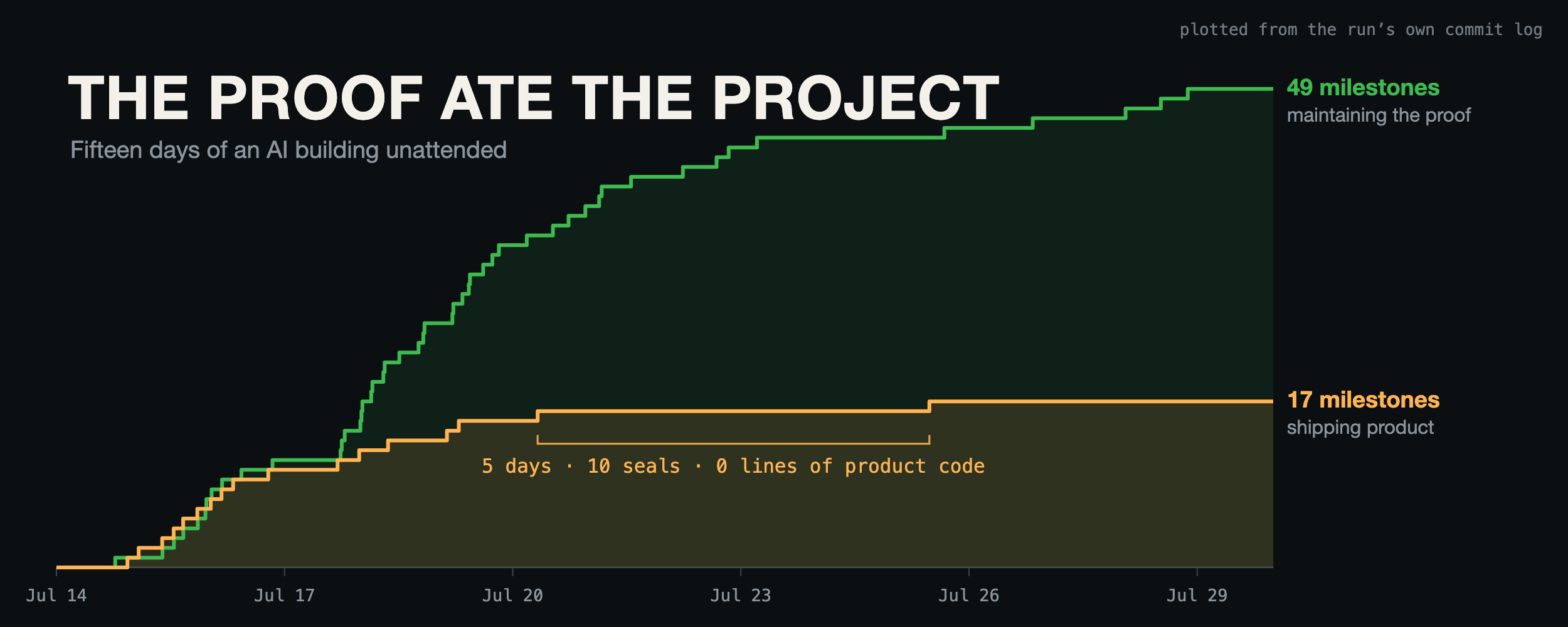
Live right now: autopilot's second stress test — 18+ days autonomous on Codex 5.6, every claim backed by a recorded receipt. See the mid-run debrief, failures included.
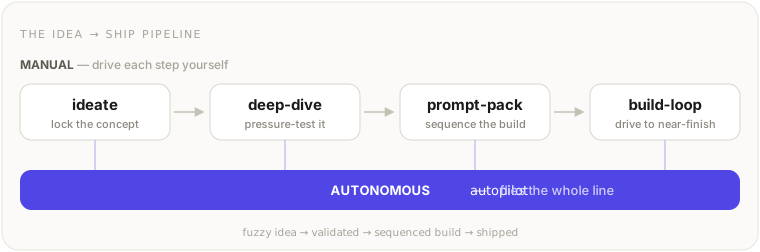
They're separate, composable skills on purpose — sharp triggers, lean context, independent use. Run them by hand (the manual tier), or let autopilot fly the whole line for you (the autonomous tier).
Who it's for. Solo and small-team builders who tend to start coding before deciding what's actually worth building — working in Claude or OpenAI Codex. If you've shipped a feature nobody used, rebuilt something and lost the parts that worked, or watched a big change stall halfway, this suite front-loads the discipline that prevents it. Each skill also earns its keep alone. (deep-dive is token-hungry by design — see its note below; it shines most when you're not token-constrained, e.g. on a Claude Max plan.)
The pipeline
ideate— turn a fuzzy idea (or an existing thing you want to improve) into a locked concept + roadmap, captured in one livingCONCEPT_BRIEF.md. A blunt, honest co-founder: it forces a success metric and a kill criterion, refuses to spec before the concept survives an honest pressure-test, and hands off cleanly toprompt-pack.deep-dive— the rigor engineideateleans on for high-stakes validation (and that you can run directly on any codebase, strategy, design, or research question): parallel specialist agents → synthesis → adversarial red-team → a plain-English verdict with honest 1–10 confidence.prompt-pack— turn a settled concept into a sequence of self-contained, independently-shippable build prompts: each does one unit, verifies itself, and leaves the app working before the next. Run them in one chat or spread across many — each prompt is self-contained, so any unit moves cleanly to a fresh chat whenever you want (or need) one. Also writes paste-ready handoffs to resume a chat or relay work to another tool.build-loop— drive a build past "it compiles" to near-finish-line craft: it sees and exercises the running app — render → screenshot → critique → rebuild, multi-pass — and checks the machine facts (build, tests, flows, console, a11y) until acceptance criteria pass or a stop-condition fires (no infinite thrash). When feel is load-bearing the visual design loop runs every iteration. Honest bound: objective craft + a self-graded taste pass, ~80% of the way — not a finished or validated product.
→ drive each step yourself, or let autopilot fly the whole line autonomously — in character as a grounded founder-persona — handing back a near-finish-line first draft plus an honest ledger of what only a human or the market can finish.
→ Already have a codebase? audit-and-fix points the same autonomy backwards: audit → triage → fix, skipping ideation entirely (your code is the grounding) and stopping at verified local commits. It's also the natural second pass on an autopilot run — autopilot hands back a first draft with a known correctness/security tail, and that tail is exactly what audit-and-fix is built to attack. (It doesn't close the taste or market half of that tail; those stay human.)
Quickstart — try one first
| If you want to… | Type this | You get back |
|---|---|---|
| Decide what to build | "I have an idea for X — help me decide if it's worth building." | docs/CONCEPT_BRIEF.md |
| Investigate something rigorously | "Do a standard design evaluation of X. Research-only." | research/<topic>/ + an executive briefing |
| Turn settled scope into a build plan | "Make a prompt pack from docs/CONCEPT_BRIEF.md." (or "X is too big for one chat — make me a prompt pack.") | docs/<TOPIC>_PROMPT_PACK.md |
| Drive a build to near-finish-line craft | "Loop on this until the core flows pass and the UI holds its design bar." | a self-verified, iterated build + an honest craft ledger |
| Fly the whole pipeline autonomously | "Run autopilot on X." | a CONCEPT_BRIEF, a build pack, a first-draft app + an honest hand-off |
| Audit a repo and fix what's found | "Audit this repo and fix what you find." | an audit + a triage verdict → verified local commits + an honest ledger |
Each works standalone; run them in sequence — or on autopilot — for the full idea→ship pipeline.
See what you actually get back — a worked example (click to expand)
ideate → docs/CONCEPT_BRIEF.md (excerpt — the locked concept + honest verdict, edited in place across the session, not regenerated):
- Confidence verdict: 7/10 — would move to 8 if 5 target users confirm the triage pain in interviews; down to 4 if they already tolerate shared Gmail.
- One-line promise: Every client message handled by the right person, fast — without anyone owning a chaotic shared inbox.
- Beachhead persona: 2–6 person creative/client-service studios. (Secondary: solo freelancers — not v1.)
- Success metric: % of client messages with a clear owner + reply within 1 business day.
- Kill criterion: If 5 target studios won't try a 2-week pilot, shelve it.
- Scope OUT / deferred: Outlook, analytics dashboard, mobile app — each named with a one-line reason.
- LOCKED: Layer on existing email, don't replace it — lowers switching cost (the wedge).
deep-dive → research/<topic>/NN-executive-briefing.md (excerpt — verdict-first, after parallel specialists + an adversarial red-team):
TL;DR. Sound core; one blocker before you ship. Confidence: 6/10 — 4 of 7 load-bearing findings externally verified (tests +
git); the rest rest on model judgment.
- [Blocker] Currency rounding diverges between server and client —
pricing.ts:142vsformat.ts:88.- [High] No regression test covers the refund path; a silent change there ships unnoticed.
- Should you proceed? Fix the blocker, add the refund test, then ship Phase 1.
prompt-pack → docs/<TOPIC>_PROMPT_PACK.md (excerpt — one self-contained, independently-shippable unit; reads the brief above):
P2 · Add per-currency rounding — Risk: HIGH Read first:
CLAUDE.md,docs/CONCEPT_BRIEF.md,pricing.ts— verify file:line before editing. What MUST NOT change: the publicformatAmount()signature; existing USD output. Verification:npm test pricing+ manual matrix (regression: USD unchanged · new: JPY 0-decimal, BHD 3-decimal). When done: report files changed + test results. Do not commit — wait for explicit go.
The skills
Manual tier — drive each step yourself.
🧭 ideate — find & validate what to build
Fuzzy idea → locked concept + roadmap. Two modes: greenfield (a new idea) and refinement (evaluate/improve an existing thing). Triggers: "help me figure out what to build", "is this idea any good", "should I rebuild X", "turn my idea into a plan". → ideate-skill
🔬 deep-dive — investigate it rigorously
Multi-agent investigative analysis for questions that deserve more than a one-shot answer: audits, strategy/viability evaluations, design reviews, open research. Triggers: "do a deep dive", "thorough audit", "evaluate this strategy", "is this sound/safe". → deep-dive-skill
Note —
deep-diveis token-hungry by design. A full run fans out 4–6 specialist agents (each writing thousands of words), then synthesis, follow-up verification, a red-team pass, and a briefing — easily 10+ agent calls and tens of thousands of tokens for one analysis. That's the right trade for a high-stakes call, and a great fit on a Claude Max plan (or any setup where you're not token-constrained). On a smaller plan, reach for it deliberately: lean on its built-in Scale heuristics (2–3 lanes for narrow scope, skip the red-team for low-stakes work), or ask for a single-pass review instead.ideateandprompt-packare far lighter.
📦 prompt-pack — turn it into a shippable plan
A big job → ordered, self-contained prompts, each shippable on its own, plus handoffs. Run them in one chat or across many. Triggers: "make a prompt pack", "break this into phases", "I'm running out of context", "write me a handoff". → prompt-pack-skill
Autonomous tier — the pipeline drives itself.
Experimental — and honest about why. The autonomous tier is an early, lightly-proven experiment: genuinely capable and a lot of fun to watch, but not battle-tested — treat it as a promising prototype, not a production tool. It produces a near-finish-line-aimed first draft a human finishes — not a finished or market-validated product. Three limits it doesn't escape: a ~80% craft ceiling with a last-mile correctness/security/taste tail; the grounding firewall (real data may discover the problem and seed the build, but a synthetic persona's reaction never counts as validation); and judgment quality isn't cleanly measurable — its go/kill calls are a signal a human weighs, never proof. Market validation stays the human handoff. Two stress tests so far: a 13.5-hour overnight run on Claude (the case study), and an 18+ day autonomous run on Codex 5.6 that is still going (mid-run debrief).
And it's token-heavy. A single
autopilotrun drives the whole pipeline — adeep-dive, a multi-pass visual loop, a different-model critic — so it can span hours to weeks and a lot of tokens (the 13.5-hour run: ~24.1M fresh / ~784M processed, 97% prompt-cache reads; the ongoing Codex run is in the billions on its root session alone). Both stress tests ran top models at maximum effort (Fable 5 with Ultracode; Codex 5.6 Sol Ultra) — cost scales with model tier, effort setting, and the size of the mandate, and the suite is untested on smaller, faster models. Best on a bigger plan (e.g. Claude Max) or any setup where you're not token-constrained; on a smaller plan, reach for the manual-tier skills directly, or scope the run tight.
🚀 autopilot — fly the whole pipeline autonomously
Runs ideate → deep-dive → prompt-pack → build-loop end-to-end, in character as a grounded founder-persona — composing the manual-tier skills, never reimplementing them. Hands back a CONCEPT_BRIEF, a validated build pack, a first-draft product, and an honest ledger of what only a human/market can finish. Carries execute-discipline (build only the gated scope; emit a human-only gate, never fake it). Stress-tested on a 13.5-hour unattended run (the case study) and an 18+ day autonomous Codex 5.6 run, still in progress (mid-run debrief). Triggers: "run autopilot", "build this idea→ship autonomously", "fly the whole pipeline end to end". Suite-only — no standalone repo.
🔁 build-loop — drive a build to near-finish-line craft
Loops build → see → exercise → check → critique → rebuild over the agent's existing tools (headless screenshot + vision to see, Playwright to exercise, axe/Lighthouse to check) until acceptance criteria pass or a stop-condition fires — no infinite thrash. When feel is load-bearing it runs a mandatory, multi-pass visual design loop (render → critique → fix → re-render, every iteration) with a different-model critic as the taste check. Honest bound: it flags ugly/broken/missing reliably but stays self-graded on genuinely good → a human spot-check is the final taste gate; market validation is out of scope. Triggers: "tighten this build", "iterate until it passes", "self-verify the UI". Suite-only — no standalone repo.
🔧 audit-and-fix — audit an existing repo, then fix what's worth fixing
Runs deep-dive → triage → prompt-pack → build-loop on a codebase you already have — composing the manual-tier skills, never reimplementing them. autopilot builds something that doesn't exist and risks inventing demand; audit-and-fix repairs something that does and risks breaking working software. Ideation is dropped entirely — your codebase replaces it as the source of truth. Its signature move is the triage verdict: not "here are 30 findings," but what's worth fixing given where you're headed — an opinion, not a menu. Then one gate, and it runs to completion unattended: sequenced units, a red-first regression test per fix, verification receipts, one commit per verified unit. Honest bounds: a receipt records what ran, it never proves correctness; it only fixes what the audit found; the live/real-world tail (real accounts, the first CI run) is never cleared; and it stops at local commits — never pushes, merges, tags, or publishes. Triggers: "audit this repo and fix what you find", "audit and edit", "deep dive then fix the bugs", "autopilot this repo but skip the ideation". Suite-only — no standalone repo.
An optional ground module — real data to seed the persona and the build — is planned; the autonomous tier runs fully without it, and the firewall holds either way.
Case study: a 13.5-hour autonomous run
I pointed autopilot at the heaviest mandate I could write (find your own grounded niche, build a real frontend and backend, hold a serious design bar, don't stop to ask) and went to bed. It ran unattended overnight and came back with Redline: a working design-crit engine for AI-built frontends. Paste a URL, a deterministic render-and-measure pipeline crits the page like a designer would, with typed findings and visual evidence.
The numbers below were re-verified from git, the session transcripts, and a cold re-run of the test wall in an isolated copy. Not self-reports.
- 13.5 hours wall clock, 22 commits, 16/16 prompt-pack units passed, zero human interventions
- ~27,000 lines of TypeScript; 387 unit tests + 92 e2e, all reproduced green
- 47 build/critic passes, a 13-agent deep-dive, 372 screenshots kept as evidence
- ~24.1M fresh tokens (~784M processed, 97% of that prompt-cache reads). Plan accordingly.
- 7 human gates emitted and left open, none faked: API keys, deploy sign-off, taste review, market validation
And the half that makes this worth reading: the product thesis is unproven (the engine was calibrated and validated on the same 24 sites), and the build shipped with a known, documented, unfixed SSRF vulnerability parked behind a do-not-deploy checklist it could not clear itself. That is the ~80% ceiling, with receipts.
- The write-up (exact kickoff prompt, verified numbers, where it failed): docs/CASE_STUDY_REDLINE.md
- The artifact itself (full 22-commit history, ledgers, gates, the debrief): redline-autopilot-case-study
The built product must not be deployed publicly as-is. Details and disclaimers in the case study.
A second, heavier stress test is running now: 18+ days autonomous on Codex 5.6 under one hard rule — every claim has to carry a recorded receipt. The mid-run debrief (receipts and failures both) is at proof-ate-the-project; the live build repo is countershape.
Also built with it
Redline is the stress test — one heavy ask, on purpose. These are the ordinary use: real tools I needed, built with the suite and public, so the claims here have something to check.
- wake — a fleet supervisor for coding agents. More useful here as provenance than as a product: the
audit→fixruns this repo distills were run on wake, so the failures inaudit-and-fix's rules table — the non-reproduction that turned out to be luck, the "zero adapter changes" plan that was wrong, the stray binary that staled a receipt — happened in that git history. Every rule was paid for; that's where the receipts are. - didrun — the evidence recorder
audit-and-fixleans on: it records what actually ran (argv, real exit code, tree state) and grades claims against a sealed commit. Dogfooded hard — the ongoing Codex stress test surfaced enough recorder bugs to ship didrun v0.2 mid-run, built directly from those findings. The skill needs a receipt tool, not this one; the discipline is portable, the tool is mine.
Read the honest version of that claim. These were built with the method
audit-and-fixdistills — not the skill, which postdates them by months. That distinction is load-bearing: the skill's own bounds say itsbuild-loop-per-unit seam has never actually run. So wake is evidence the audit→fix method works and that its rules were earned — it is not evidence the skill is proven. Nothing here has been through it end-to-end yet.
How they compose
ideateproduces aCONCEPT_BRIEF.md— the single artifactprompt-packconsumes to author build prompts. (ideate delivers the what & why; prompt-pack derives the how from your actual code.)ideatedelegates todeep-divewhen a concept needs heavy, current-sourced validation, and folds the verdict back into the brief.build-loopdrives any build — from aprompt-packstep or on its own — toward near-finish-line craft; it's the craft engine the autonomous tier leans on.autopilotcomposes all four (ideate → deep-dive → prompt-pack → build-loop) to fly the whole pipeline autonomously — orchestration only, never reimplementing them.audit-and-fixcomposes three of them (deep-dive → prompt-pack → build-loop) in the other direction:deep-divegenerates the work instead of validating a brief, and its Tier 0/1/2/3 fix list — already sized for one work session each — becomesprompt-pack's units directly. The two orchestrators share a tier and a discipline, but never each other's risks — and they chain:autopilot→audit-and-fixis the common second pass, aimed at the correctness/security tail autopilot's ~80% ceiling leaves behind.- Each is also fully useful on its own — run
deep-diveto audit a codebase,prompt-packto sequence a refactor,ideateto gut-check an idea,build-loopto tighten a build — without the others.
Which skill for which question? (they overlap on "evaluate / plan" — here's the precedence)
| The user is really asking… | Skill | Then |
|---|---|---|
| What should I build? Is this idea worth pursuing? | ideate | locks a CONCEPT_BRIEF.md; delegates heavy validation to deep-dive mid-funnel |
| Is this correct / safe / viable / evidence-backed? | deep-dive | returns a verdict + confidence; if it was validating a concept, hands a block back to ideate |
| Scope is settled — sequence the build | prompt-pack | reads CONCEPT_BRIEF.md if present; offers ideate first if the idea is unsettled |
| Does this build actually work + hold a craft bar? | build-loop | loops see/exercise/critique until it passes or a stop-condition fires |
| Build the whole thing for me, autonomously | autopilot | flies ideate→…→build-loop in-character; hands back a first draft + an honest ledger |
| Audit my repo and fix what you find | audit-and-fix | audits read-only, triages against your next goal, takes one go, then fixes to verified local commits |
| Genuinely unclear | ask one question | viability direction, rigorous audit, execution-planning, or autonomous build? |
deep-dive vs. audit-and-fix — they overlap on "audit this codebase", so: deep-dive answers "is it sound?" and stops. audit-and-fix answers "is it sound, what's worth fixing given where you're headed — now go fix it." No intent to change the code → deep-dive (it's also far cheaper).
These compose, but each also runs alone — install only the one you need.
Install
These follow the open Agent Skills standard, so they run in Claude and OpenAI Codex — install them all as a Claude Code plugin, drop them into your Codex skills folder, or copy individual skills anywhere. Pick your setup:
| You use… | Get them all by… |
|---|---|
| Claude Code — terminal, the Code tab of the Claude desktop app, claude.ai/code, or a VS Code / JetBrains IDE | the plugin (Option 1), or a manual copy (Option 2) |
| OpenAI Codex — CLI, app, or IDE | copying the skills into ~/.agents/skills/ (Option 2) |
| Claude chat — the Chat tab of the desktop app, or claude.ai (non-coding use) | uploading each skill's .skill zip (in this repo root) under Customize → Skills. Best for ideate; the others want repo/file access (and build-loop/autopilot want the build tools too). |
| Any other agent | pointing it at any skills/<name>/SKILL.md — it's just instructions |
"Claude Code" and "Claude chat" both live in the one Claude desktop app — its Code tab vs its Chat tab (plus their terminal / web / IDE surfaces). Plugins install in Claude Code only; the Chat tab takes uploaded skills under Customize → Skills.
Compatibility by skill × surface
The skill format is portable; some runtime features (parallel subagents, progress tools, web/repo access, a headless browser) are richest in Claude Code and Codex. Each skill still runs everywhere — degraded cells lose mechanics, not method.
| Skill | Claude chat | Claude Code | OpenAI Codex | Other agents |
|---|---|---|---|---|
| ideate | Strong — concept work; brief kept inline when there's no file tree | Best | Strong — with a local workspace for the brief | Works — full method; keep the brief in a file or inline |
| deep-dive | Works (degraded: no repo/file access; lanes run serially) | Best — parallel subagents + web | Strong — same lanes run serially (lower cross-agent independence, so confidence is capped); external claims labeled unverified if no web | Works (degraded: serial lanes, local-only; label external claims unverified) |
| prompt-pack | Limited — best for high-level planning/handoffs; weak without repo access | Best | Best — reads AGENTS.md, full repo access | Works — with repo/file access |
| build-loop | Limited — no headless browser/Playwright; degrades to build/test/static checks (say so) | Best — interactive renderers + Playwright + a different-model critic | Strong — Playwright screenshot loop; the critic needs a separate model available | Works — wherever bash + a headless browser run |
| autopilot | Not recommended — needs the full pipeline's tools | Best | Strong — the suite's heaviest run to date is autopilot on Codex 5.6: 18+ days autonomous and counting (mid-run debrief) | Works — with repo + tool access |
| audit-and-fix | Not recommended — needs repo access, bash, and git | Best — parallel audit lanes + autonomous unit execution | Untested — inferred. Should be strong (reads AGENTS.md, full repo access; audit lanes run serially, so confidence caps accordingly), but nobody has run it there yet | Works — wherever repo access + bash + git run |
Menu names/commands drift between versions — the linked docs are the source of truth. Claude-specific bits (the plugin manifest format; deep-dive's parallel-subagent orchestration) don't all carry to Codex; the methodology is fully portable — deep-dive ships an Environment & fallbacks section that runs the same lanes serially when subagents aren't available, and build-loop falls back to a Playwright screenshot loop where interactive renderers aren't.
On the autonomous tier specifically: its design loop leans on a different-model critic + parallel orchestration that are richest in Claude Code — where it can spawn a genuinely different model to grade taste. In our runs the design output was noticeably stronger on Claude; the pipeline ran end-to-end on both. Reach for Claude when feel is the wedge — and either way, a human spot-check stays the final taste gate.
Option 1 — Claude Code plugin (all skills, namespaced)
/plugin marketplace add nelsonwerd/idea-to-ship-skills
/plugin install idea-to-ship@nelsonwerd
Or, in the desktop app's Code tab: click + next to the prompt → Plugins → add this marketplace and install. The skills become /idea-to-ship:ideate, /idea-to-ship:deep-dive, /idea-to-ship:prompt-pack, /idea-to-ship:autopilot, /idea-to-ship:build-loop, /idea-to-ship:audit-and-fix and auto-activate on matching requests (run /reload-plugins if they don't appear).
Already have the skills installed manually? They still work. To avoid duplicate names, remove the old copies first:
rm -rf ~/.claude/skills/{ideate,deep-dive,prompt-pack,autopilot,build-loop,audit-and-fix}. (The plugin namespaces its skills, so it won't collide.)
Option 2 — copy the skills (any tool, always works — and the Codex path)
git clone https://github.com/nelsonwerd/idea-to-ship-skills.git
cp -r idea-to-ship-skills/skills/* ~/.claude/skills/     # Claude Code
cp -r idea-to-ship-skills/skills/* ~/.agents/skills/     # OpenAI Codex
No restart needed in Claude Code (it detects them in-session); restart Codex to load skills dropped into ~/.agents/skills/ (Codex also scans a repo-level .agents/skills/ if you want a skill in one project only). Then use them directly (/ideate in Claude; /skills or just describe the task in Codex) or let either tool auto-activate by description.
Updating: the Claude plugin uses commit-SHA versioning, so every push to this repo counts as an update — no version bump to wait on. In Claude Code, run
/plugin update(or turn on auto-update for the marketplace in/plugin→ Marketplaces, and it refreshes at startup). For a copied install (Codex via~/.agents/skills/, or a manual Claude copy),git pulland re-copy.
Why this exists
Each skill encodes a specific failure mode it prevents — learned the hard way from real builds:
- ideate stops you from speccing before validating and from building with no success metric or kill criterion.
- deep-dive stops you from trusting a confident one-shot answer on a high-stakes call — it red-teams its own conclusions and cites current sources.
- prompt-pack stops a big build from drifting or leaving the app half-broken between steps — and keeps each unit small enough to outlast a context limit if you hit one.
- build-loop stops a build from looking done while half-wired — it renders and exercises the real UI instead of trusting that it compiles, and reports a check it couldn't run as not run, never green.
- autopilot stops an autonomous run from overbuilding past its validated scope or faking a gate it actually abandoned — the sharpest failure mode of "agent, go build it."
- audit-and-fix stops an audit from dying as a list nobody actions — and stops the fixing from quietly breaking the working software it was sent to improve: every fix traces to a finding, proves it could reproduce the bug first, and lands only behind a receipt and an untouched regression fence.
Small, sharp, composable tools across two tiers — not one monolith. That's the point.
Standalone homes
This repo bundles the suite. The three manual-tier skills also have canonical standalone repos; the autonomous-tier skills live in the suite repo + live installs only (no standalone repo yet):
| Skill | Repo |
|---|---|
| ideate | https://github.com/nelsonwerd/ideate-skill |
| deep-dive | https://github.com/nelsonwerd/deep-dive-skill |
| prompt-pack | https://github.com/nelsonwerd/prompt-pack-skill |
| autopilot | suite-only — no standalone repo |
| build-loop | suite-only — no standalone repo |
| audit-and-fix | suite-only — no standalone repo |
| case study (the heavy autonomous run) | https://github.com/nelsonwerd/redline-autopilot-case-study |
License
MIT © 2026 Drew Nelson